Backend & API engineer
← All articles

[ 01 / 05 ] routre

A Local LLM Gateway That Cuts Agent Token Bills

routre is one static Go binary between your coding agents and every LLM provider. It compresses the tool output that dominates agent traffic, replays identical requests from cache, and fails over to the next provider when one is busy — while holding the API keys so the client never sees them.

Role
Go backend & systems engineering
Stack
Go 1.26, standard library only — no Node, Python, Postgres or Redis
Footprint
~10.9 MiB static binary, ~12.6 MiB idle RSS
Verified
Re-read against commit 849ad95 (2026-10-25). Screenshots and demo output are from the 2026-10-17 run.

At a glance

  • What it is — a localhost reverse proxy for OpenAI- and Anthropic-compatible APIs. Point OPENAI_BASE_URL or ANTHROPIC_BASE_URL at 127.0.0.1:20128 once, and every agent behind it gets failover, compression and caching for free.
  • Who it's for — anyone running several coding agents (Claude Code, Codex, opencode, Cursor) who pays per token.
  • The interesting part — the gateway is a pipeline, not a load balancer. Seven steps run on every request, and each one is bounded so it cannot make a request slower than the provider would have been.

The problem

Agent sessions are mostly tool output — file reads, grep hits, test logs, diffs — sent back to the model over and over. Three costs follow.

  1. You pay for repetition. The same test log is billed again on the next turn.
  2. You pay for duplication. A byte-identical request buys a byte-identical answer a second time.
  3. You stop working when a provider does. One provider hiccup becomes a failed agent run unless something else can answer.

routre fixes all three at the point where tokens are billed.

What it does

CapabilityHow
Compress tool output11 heuristic filters for diffs, grep, trees, build logs and long output, applied to tool_result content. Fail-open; a payload never grows.
Replay exact requestsSHA-256 of the canonical body after compression. Streaming and non-streaming entries never cross.
Fail over by tierProviders are grouped subscription → cheap → free; a failure moves down a tier and cools the failed provider down (2 s to 5 min).
Translate dialectsAn OpenAI client can stream from Anthropic, and the reverse, via an in-flight SSE state machine.
Track tokens and costPer-agent requests, tokens, compression and cache savings, and estimated cost, persisted to ~/.routre/usage.json.
Keep control localA loopback dashboard edits keys and config. Keys live in a 0600 env file; a client's Authorization header is never forwarded.

How it works

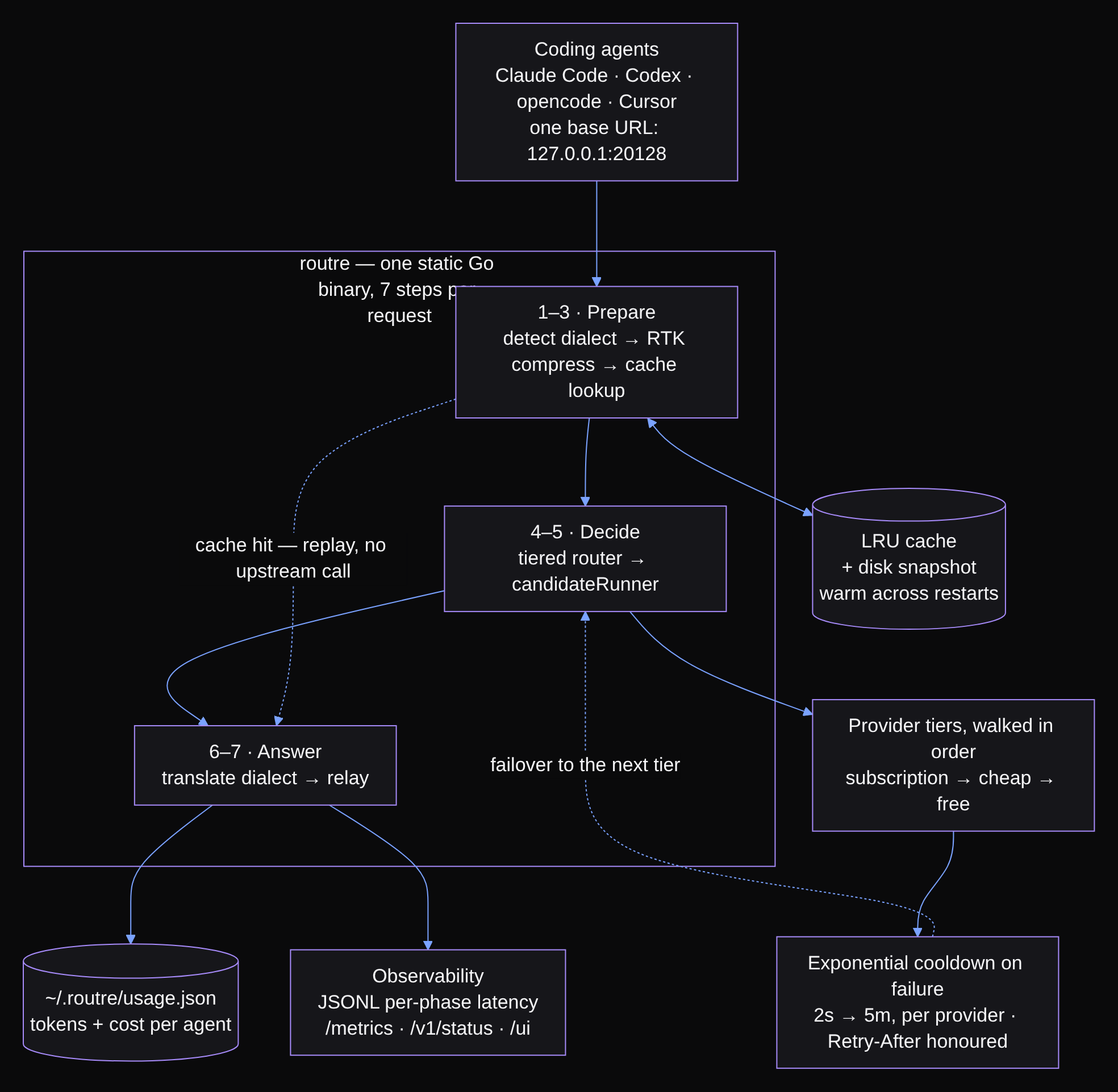
routre architecture
Mermaid source (diagrams/routre.mmd)
flowchart TD
  AG["Coding agents<br/>Claude Code · Codex · opencode · Cursor<br/>one base URL: 127.0.0.1:20128"]

  subgraph PIPE["routre — one static Go binary, 7 steps per request"]
    direction TB
    S1["1–3 · Prepare<br/>detect dialect → RTK compress → cache lookup"]
    S2["4–5 · Decide<br/>tiered router → candidateRunner"]
    S3["6–7 · Answer<br/>translate dialect → relay"]
    S1 --> S2 --> S3
  end

  CACHE[("LRU cache<br/>+ disk snapshot<br/>warm across restarts")]
  TIERS["Provider tiers, walked in order<br/>subscription → cheap → free"]
  CD["Exponential cooldown on failure<br/>2s → 5m, per provider · Retry-After honoured"]
  LEDGER[("~/.routre/usage.json<br/>tokens + cost per agent")]
  OBS["Observability<br/>JSONL per-phase latency<br/>/metrics · /v1/status · /ui"]

  AG --> S1
  S1 <--> CACHE
  S1 -. "cache hit — replay, no upstream call" .-> S3
  S2 --> TIERS
  TIERS --> CD
  CD -. "failover to the next tier" .-> S2
  S3 --> LEDGER
  S3 --> OBS

Components

  • internal/proxy/ — the HTTP gateway and the seven-step pipeline. runner.go is the failover loop: when to retry, when to refresh a key, when to give up.
  • internal/proxy/dialect/ — the SSE state machine that lets one address serve OpenAI and Anthropic clients.
  • internal/rtk/ — the 11 compression filters, bounded by a 512 KiB scan window and a 150 ms budget.
  • internal/cache/ — the exact-match LRU plus the on-disk snapshot.
  • internal/router/ — tier walking, per-provider cooldown and model discovery.
  • internal/usage/ and internal/config/ — the savings ledger and the reloadable config.json + routre.env pair.

One request, end to end

  1. Detect the dialect. Read the path and body to decide whether the caller speaks OpenAI, Anthropic or the Responses API, then normalise the request.
  2. Compress. Shrink tool_result bodies; if a filter cannot help, the payload passes through unchanged, and work stops at the scan window or the time budget rather than delaying the call.
  3. Look up the cache. Hash the canonical post-compression body. A hit replays the stored response byte for byte with no upstream call — in my run, the second request returned in 2 ms.
  4. Route and retry. Pick the cheapest healthy provider, try one connection-level retry and one free auth refresh on 401/403, then move on. Once a first byte has been emitted, failover stops rather than duplicate output into a half-read stream.
  5. Translate and relay. Rewrite the upstream stream into the caller's dialect, record latency, and update the ledger.

Key choices

ChoiceWhyCost
Bounded, fail-open compressionEvery filter must return something no larger than it received, and the stage stops at 150 ms. Compression can never be the reason a request fails.Some payloads a slower algorithm could shrink are left alone.
Exact-match cachingA hit is provably the same request, so a deterministic run cannot be poisoned by a near-miss.A lower hit rate than a fuzzy or semantic cache.
Failover bounded by a budgetEach provider gets a 45 s soft slice inside the request budget, plus one 45 s extension when the socket is alive.A client can see a request run past the soft slice.
Loopback-first securityBind 127.0.0.1; reject non-loopback Host/Origin headers; keep keys in a 0600 file.Not designed for a shared or public network.

Running it

git clone https://github.com/mariobgsp/routre && cd routre
make build
./routre version

./routre setup                  # writes config.json + routre.env (0600)
./routre serve                  # gateway on 127.0.0.1:20128
curl http://127.0.0.1:20128/healthz

export OPENAI_BASE_URL=http://127.0.0.1:20128
export ANTHROPIC_BASE_URL=http://127.0.0.1:20128

What I observed

request 1:  X-Llrouter-Cache: miss   X-Llrouter-Provider: openrouter-economy
request 2:  X-Llrouter-Cache: hit

ledger:  2 requests · 15 tokens used · 9,643 saved (9,633 RTK + 10 cache)

Two facts are reproducible: the second request never reached a provider, and the first reached the second tier because the first failed. The 99.8% saving comes from a deliberately repetitive fixture. The headline is the CI-gated 94.8% aggregate and 93.3% worst-payload tool-token reduction, measured by make bench, failing below 90%. It applies to tool-result tokens only.
Screenshots

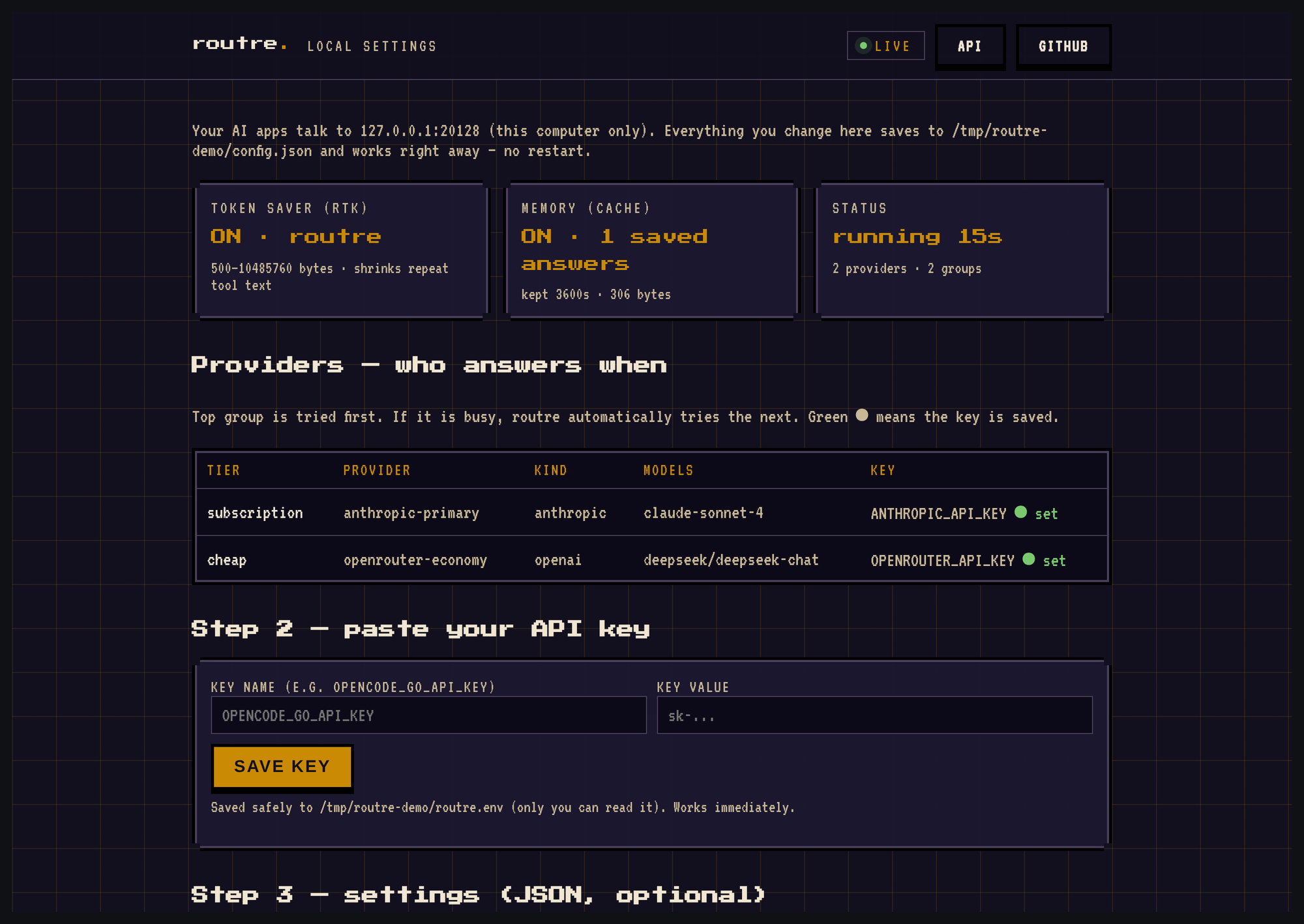
routre dashboard

The embedded dashboard: compression and cache state, provider tiers, and key presence. Captured against the mock upstream, so no real keys or spend are involved.

What I'd fix next

  • Non-streaming openai → anthropic translation is missing. Streaming handles every pair, but a non-streaming Anthropic client routed to an OpenAI provider gets the raw OpenAI body. tests/e2e_test.go pins the gap.
  • Token estimates are approximations (about 4 bytes per token): fine for a benchmark, wrong for billing. Real BPE counts already exist for payloads under 64 KiB.
  • Windows self-update is deferred. routre update prints a re-install hint instead of replacing a running executable.