Backend & API engineer
← All articles

[ 02 / 05 ] durable-agents

Agents That Survive a Crash

A local agent fleet you drive from Telegram: one daemon owns the durable state, so a dropped long poll, a killed process or a lost network costs you nothing. Agents can message each other, run on schedules, edit their own system — and there is no browser left to reload.

Role
TypeScript / systems engineering: durable execution, transport design, process supervision
Stack
Node + TypeScript (packages/cli · packages/core · packages/telegram) · one daemon over a 0600 Unix socket · Telegram Bot API · SQLite via @earendil-works/pi-durable 1.3.0
Verified
Re-read against 61ddadb (2026-10-30). Checks are my run at 9138f67; the only commit since is the README fix below: npm run check clean, npm run e2e 23/23, npm run bench 5/5 at 222 MB peak PSS.

At a glance

  • What it is — a single-user agent fleet with no web app: one daemon owns the durable conversations, a CLI does setup and administration, dura monitor renders the fleet, and one Telegram bot per agent is the chat surface.
  • Who it's for — someone who treats an agent session as work rather than a prompt: long threads, expensive generations, a phone as the client, and a strong preference not to lose either because a long poll died mid-answer.
  • The interesting part — durability is not a save button and not a UI feature. It is a durable task log inside one process, and the transport is treated as disposable: Telegram can fail, rate-limit, or be replaced, and the run carries on.

The problem

A chat UI that keeps the conversation in the client breaks as soon as a turn costs money and takes minutes. Moving the same assumption to a phone transport does not fix it, it hides it:

  • A dropped connection loses the answer. The generation completes upstream, but nothing durable owns it, so the reply never lands.
  • A restart forgets what was in flight. There is no record that a turn was running, so resuming means re-asking and re-paying.
  • "Still working?" has no answer. A typing indicator cannot distinguish a slow generation from a dead one, and in a group it cannot say which agent is mid-sentence.
  • A second message is a second question. Send another line to a busy chat and most systems queue a new turn behind the first, so the correction arrives after the money is spent.

This project inverts the ownership: the daemon writes durable tasks first, and the transport is a view onto that log.

What it does

CapabilityHow
Durable threadsEvery message, tool call and generation is a durable task in app.sqlite. resume() replays interrupted work, and an answer is read out of the log rather than off a socket.
Steering, not queueingA message sent while a run is live is steered into it (whenBusy: "steer") and answered with Steer · added to the current run. /stop aborts the run and withdraws the queued messages.
One bot, one agentA bot belongs to exactly one agent, so identity is never ambiguous. An unpaired bot answers only the owner with a pairing prompt; pairing takes a token (/connect <agent> <token>, the token message is deleted, or bot_connect from the orchestrator), never browser automation.
Agents as filesagents/<id>/{agent.json,AGENT.md,SOUL.md,MEMORY.md,.history/}. Every mutation goes through one admin pipeline — validate, write, rebind, reconcile mesh and schedules — and a filesystem watcher rebinds a hand edit.
OrchestratorA config pointer, not a special agent: role-scoped tools (agent_admin_list, agent_read, agent_create, agent_update, agent_set_enabled, agent_delete, bot_list/assign/release/connect, mcp_*) plus agent_write_doc with a sha256 guard, patch mode, a 64 KiB cap and five versions of history. Any agent may call orchestrator_claim; if an orchestrator already exists the owner gets Approve/Deny buttons.
GroupsThree modes — Nyahut (agents claim a message by responsibility), Moderator, Silent — with one speaker bot per room and a chatId+messageId seen-map that suppresses duplicates when several bots are present.
Agent networkagents_message delivers to one directed inbox thread per sender–recipient pair; agents_delegate creates one task thread per target. Calls are idempotent by request id.
SchedulesA per-agent 5-field cron owns one thread: run-now, skip-when-busy, restart-safe; a missed window is counted, not replayed.
Global MCPstdio servers installed once, exposed to every agent as mcp__<server>__<tool>, with every conversation rebound on install or removal so existing threads gain the tools immediately.
Bounded dataRetention is automatic: threads older than 3 days are soft-deleted, tombstones are exported and purged 3 days later, then vacuumed. Before a batch disappears, one summary per agent is appended to its MEMORY.md.
OperationsA five-step resumable dura init, dura verify (provider, bot identity, owner delivery, socket/no-TCP, SQLite, one live agent round-trip) which writes setup.verifiedAt only on a pass, plus status, monitor, logs -f and doctor.

How it works

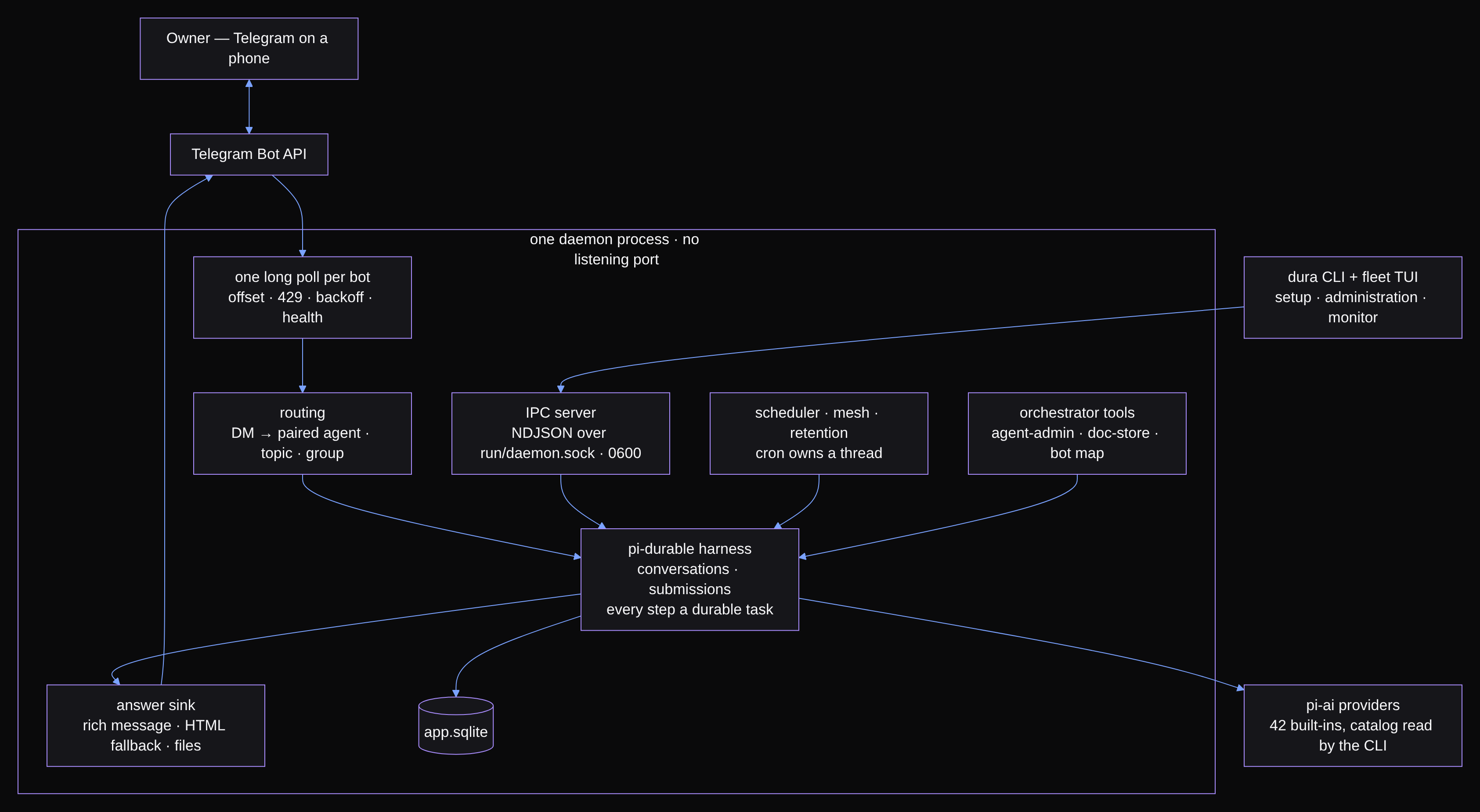
durable-agents architecture
Mermaid source (diagrams/durable-agents.mmd)
flowchart TD
  P["Owner — Telegram on a phone"]
  C["dura CLI + fleet TUI<br/>setup · administration · monitor"]
  TG["Telegram Bot API"]

  subgraph D["one daemon process · no listening port"]
    POLL["one long poll per bot<br/>offset · 429 · backoff · health"]
    ROUTE["routing<br/>DM → paired agent · topic · group"]
    IPC["IPC server<br/>NDJSON over run/daemon.sock · 0600"]
    H["pi-durable harness<br/>conversations · submissions<br/>every step a durable task"]
    OPS["scheduler · mesh · retention<br/>cron owns a thread"]
    ADM["orchestrator tools<br/>agent-admin · doc-store · bot map"]
    RENDER["answer sink<br/>rich message · HTML fallback · files"]
    DB[("app.sqlite")]
  end

  LLM["pi-ai providers<br/>42 built-ins, catalog read by the CLI"]

  P <--> TG
  TG --> POLL
  POLL --> ROUTE
  ROUTE --> H
  C --> IPC
  IPC --> H
  OPS --> H
  ADM --> H
  H --> DB
  H --> RENDER
  RENDER --> TG
  H --> LLM

Components

  • packages/core/src/daemon.ts, ipc.ts — the one process: harness, SQLite, scheduler, mesh, run limiter, IPC server and a poller per bot. A lockfile with a liveness check enforces a single instance, and a second dura start exits 4. Readiness is a 0600 file plus one DURA_READY line on stdout, so a detached start needs no pipe.
  • packages/cli/src/client.ts, commands/monitor.ts — the CLI is a client and nothing else: it reads files, or speaks NDJSON ({"id","method","params"} → {"id","ok","result"}, with {"event":"fleet"} pushes) over the socket. Exit codes are part of the contract: 0 ok, 1 runtime, 2 usage, 3 daemon unavailable, 4 refused.
  • packages/core/src/stream.ts, live.ts — durable entries to wire messages, and the one reader of pi.live that derives the phase, the tool calls and the run's real elapsed time.
  • packages/telegram/src/runtime.ts, client.ts, render.ts — one getUpdates loop per bot with its own offset and health in telegram/state.json; a 20-second long poll, 429 honouring retry_after, failures backing off 1 s → 15 s, 401/409 stopping that bot only, and a shutdown that aborts the in-flight poll instead of waiting it out. render.ts holds the coalescing edit sink and the rich/HTML answer path.
  • packages/core/src/agent-admin.ts, orchestrator.ts, doc-store.ts — the single write path for agent records, the role guard, and the document store with its sha256 guard and history.
  • packages/core/src/retention.ts, sessions.ts, storage.ts — prune reads the index once and writes it once, purge exports one transcript at a time, then vacuum reclaims the file.
  • packages/core/src/cron.ts, schedules.ts, mesh.ts, mesh-tools.ts, rooms.ts, nyahut.ts — schedules, the directed agent network, and group orchestration.

One message, end to end

  1. You type into a bot's chat. That bot's poller holds its own offset; the update is claimed once, and commands bypass the thread binding.
  2. Routing: a DM goes to the bot's paired agent and its active thread, a reply routes to the thread that produced the message, a topic gets one durable thread.
  3. The daemon submits an input to that conversation and answers the chat with a short Think · planning the next step placeholder. The submission is already durable when its id comes back; a refusal throws before anything is written.
  4. While the run is live, one status message — not one per call — is edited at most every 1.2 s. It shows the phase (or the thinking text as it streams) and the last three calls in the call's own words (⚙️ bash: git status, ⚙️ read: core/src/live.ts), because twenty notifications for twenty reads is noise. A message you send now is steered into the run instead of forming a new turn.
  5. On completion the committed entry is read out of the log and sent with sendRichMessage (GFM headings, tables, task lists, long code), falling back to HTML sendMessage when the API rejects it. Generated files follow as documents.
  6. If the daemon dies at any point, the work is still in SQLite: the next poller sees the same conversation, so the answer is delivered from the log rather than re-asked.

Why there is no listening port

The daemon binds nothing. The CLI and the TUI connect over run/daemon.sock, mode 0600, and the only network traffic is outbound Bot API calls and the provider. That removes the entire class of problems a local HTTP surface brings with it — token injection, Host allowlists, CORS, a port that some other process can reach — and it is why the previous version's Tailscale runbook, X-PI-Token and token-in-page bootstrap are gone rather than relocated.

The price is honest: the chat surface is Telegram, so the phone story is "message a bot" rather than "open a URL", and anything the CLI cannot do has to become a command or a menu. dura monitor is deliberately the last of those: a read-only fleet TUI whose only write is an explicit add-agent form.

Key choices

ChoiceWhyCost
Durability belongs to the daemonThe harness writes the task first, so "the phone went to sleep during a four-minute generation" is a supported path rather than data loss.Every surface has to render state it did not create, including re-attaching to a run it never started.
The transport is disposableTelegram can rate-limit, drop a long poll or be replaced; none of that is allowed to touch a run.The answer path has two formats and a coalescing edit sink, and the API's limits become load-bearing.
One bot per agentIdentity is unambiguous: a message to that bot is that agent, never a shared roster.Onboarding needs a bot token per agent, and a bot cannot add group members, so the CLI mints an invite link.
Steer instead of queueA correction reaches the run in flight, so you are not billed for the answer you were about to cancel.The transport must edit a live message, and /stop has to withdraw a queue rather than just abort.
Streaming reads pi.liveThe provider never emits message_update, so the daemon diffs the durable message in flight.An internal shape is load-bearing; the clean fix belongs upstream.
Retention is a feature, not a cleanupAn 8 GB host with SQLite and images needs a bound, and one summary per agent keeps the gist.The default is 3 days; anything older is gone unless config.json says otherwise.
A measured memory gateFive agents with full tools must fit under 2 GB, enforced by a benchmark and by systemd MemoryHigh/MemoryMax.A run limiter (5 active, 20 queued) means you wait, and the gate has to be re-run, not assumed.

Running it

git clone https://github.com/mariobgsp/durable-agents && cd durable-agents
npm install
npm link                 # optional: `dura` on PATH
dura init                # five steps, resumable
dura status              # daemon, bots, agents, runs, memory, verification time
dura verify              # the connection test, any time
dura monitor             # fleet TUI: q quit, r refresh, a add agent
dura logs -f             # JSON lines: lifecycle, connection, conversations, errors

dura init is strictly sequential and resumes at the first unfinished step:

StepWhat it does
1 AgentsAsks for the orchestrator when missing, offers a replacement when present, stages extra agents. Nothing is written yet.
2 ProviderDetects existing credentials, defaults to opencode-go / deepseek-v4.1-flash, or adds any built-in provider by API key (validated before saving).
3 TelegramAdds bots (getMe validated), binds the owner with a short /start code, assigns a home bot per agent, then writes the staged agents atomically.
4 ServiceOffers the systemd user unit and reports zram/sysctl tuning.
5 Connection testStarts the daemon and proves provider completion, bot identity, owner delivery, socket/no-TCP, SQLite and one live agent round-trip. Only a pass writes setup.verifiedAt.

Keys never come from argv or through Telegram: a provider key is a hidden prompt, stdin (--key-stdin) or the environment, saved 0600; bot tokens live in secrets/telegram.json, 0600. Vault values are AES-256-GCM.

~/.dura-file/                  (DURA_HOME overrides)
  config.json                  0600
  credentials.json             provider keys, 0600
  secrets/telegram.json        bot tokens, 0600
  app.sqlite                   durable conversations, tasks, entries
  agents/<id>/                 agent.json, AGENT.md, SOUL.md, MEMORY.md, .history/
  artifacts/<conversation>/    generated files
  vault/                       secrets and key
  telegram/                    users.json, state.json (offsets, bindings)
  logs/daemon.log[.1..3]       JSON lines, rotated
  run/daemon.sock              0600 control socket

Agents default to permission tier full, cwd $HOME, every tool. That tier is a policy, not a sandbox: the operating-system account is the boundary, and the systemd unit's MemoryMax is the only hard limit on the process.

What I observed

These are my own numbers, run on a clean worktree of 9138f67 on this machine:

CheckResult
npm run checktsc clean; check-language: clean — no Indonesian markers in system files
npm run e2e23 passed, 0 failed, 68 s wall — telegram-chat, telegram-steer, telegram-stop, bot-pairing, bot-token-connect, orchestrator-claim(-approval), mcp-global, retention, thread-prune, verify, tui-json and the rest
npm run bench5/5 completed, 4.6 s wall, peak PSS 222 MB (gate 2048 MB), p95 199 MB, p50 84 MB
dura provider models opencode-go29 models, one per row
dura provider list --all42 providers

The E2E suite is not a mock of the transport: scripts/e2e/harness.mjs boots a real daemon in a temporary home with the faux provider and a fake Bot API, injects updates and inspects the messages, edits, callbacks, files and SQLite rows that come back. The bench (scripts/bench/five-agents.mjs) runs the same tool-heavy script in five conversations at once and samples PSS for the daemon and every descendant every 100 ms.

In use

The surface is a chat and a terminal, so what used to be screenshots is a command surface. tools/capture/durable-agents.mjs runs the CLI out of the pinned checkout with a throwaway DURA_HOME — no daemon, no socket, no model call — and writes exactly this (dura-agents 0.1.0, 42 providers, 29 models on opencode-go):

dura-agents CLI

Usage: dura <command> [options]

Setup
  init                 Guided setup: agents, provider, telegram, service, connection test
  verify               Run the connection test against a running daemon
  start                Start the daemon (foreground on a terminal, background otherwise)
  stop                 Stop the daemon
  restart              Stop then start the daemon
  status               Daemon, bots, providers, runs and memory
  logs                 Read or follow the daemon log

Configuration
  config               get, set, edit or validate config.json
  bot                  Telegram bot registry: add, list, remove, test, default
  provider             Providers: list, add, models, test, remove, default
  agent                Agents: list, show, create, set, enable, disable, delete, docs
  orchestrator         Show, set, create or replace the orchestrator
  user                 Allowlist: list, add, remove, pending, approve, invite
  service              Install, remove or inspect the systemd user unit
  tune                 Report or apply zram/sysctl tuning
  migrate              Copy an older data directory into DURA_HOME

Use
  mcp                  Global MCP servers: list, add, remove, reload, tools
  thread               List, prune, restore or purge threads (--purge --vacuum to reclaim space)
  monitor              Fleet TUI (read-only, plus an explicit add-agent form)
  usage                Usage report
  memory               Agent memory notes
  schedule             Cron schedules
  storage              Size report, cleanup, purge
  vault                Secret vault names and values
  doctor               Diagnostics
  update               Update packages and reload tools
  bench                Five-agent memory benchmark

Global: --json, --help, --version, --home <path>

The model catalog behind /model, first rows of the 29:

model                       context  input       cost/1M in
claude-haiku-5-5            1000000  text,image  0.1
minimax-m3                  1000000  text,image  0.3
qwen3.7-plus                1000000  text,image  0.4
qwen3.8-flash               1000000  text,image  0.15
qwen3.8-max                 1000000  text,image  2
gemini-4-argon-contributor  1048576  text,image  4
cat-jam-free                262144   text        0
deepseek-v4-pro             1000000  text        0.66
…

A run in the chat has this shape — the placeholder, the edited status card, then the answer. The strings are the transport's own, from packages/telegram/src/runtime.ts:

you   why did the nightly backup skip Tuesday?
bot   Think · planning the next step
bot   🧠 the schedule says Tuesday ran at 02:00…
      ⚙️ bash: rg -n "02:00" ~/backups/schedule.conf
      ⚙️ read: /var/log/backup.log
      ⚙️ bash: journalctl -u backup --since 02:00
you   also check Wednesday
bot   Steer · added to the current run
bot   <the answer, rich-formatted: headings, a table, a code block>
What I'd fix next

  • The group path has no end-to-end scenario. nyahut/moderator/silent routing is exercised by the room code, not by the transport: there is no E2E proving that a Telegram group, a bound room and one speaker bot actually produce the right answer.
  • MCP is stdio only. No HTTP or streamable transport yet, and an MCP server runs with the daemon's own OS permissions, so installing one is trusted-code territory.
  • The benchmark measures the wrong half of the risk. It uses the faux provider, so it measures daemon memory under tool load — not a real provider's network buffers. The repository also quotes 246 MB and 247 MB for the same run in two other documents; PSS moves with the rest of the machine, so the gate is the number worth reading, not the third digit.
  • dura tune does not install anything. When no zram device exists it prints the zram-generator configuration instead of applying it.
  • Direct chats are strictly one bot per agent. A group is the only multi-agent surface, and a bot cannot add members: dura user invite --chat <id> plus dura user add <id> is the manual path.
  • Voice, video, per-agent hooks and a skills curator are not implemented. Not started, and the roadmap says so rather than implying otherwise.

Two documentation defects, found by reading the code and fixed upstream. The README showed progress lines as Bash · running a command · step 1; progressLine() in packages/telegram/src/runtime.ts emits bash: git status-style lines, keeps the last three, and has no step counter anywhere in the path. And the benchmark table was followed by a raw \textit{This run used the offline faux provider; …} line, which GitHub renders as a code block rather than an italic caveat. Both are corrected in #3 — the commit this article pins.