Backend & API engineer
← All articles

[ 03 / 05 ] trading-suite

A Stock Screener That Refuses to Buy

Most screeners answer with a list. This one answers with a verdict, the measured evidence behind it, and often no. Six screens, a FastAPI backend and a data check that outranks every signal.

Role
Backend engineering, quantitative research tooling, data integrity
Stack
Python 3.11+ + FastAPI · SQLite (WAL) · Vite + React 19 + TanStack Router · yfinance / IDX
Verified
Re-read against commit e1a314a (2026-10-25). The DATA_UNSAFE output below is from the 2026-10-17 run.

At a glance

  • What it is — a self-hosted desk for the Indonesian market (IDX). Six screens and a CLI read a walk-forward study's artifacts, apply its rule chain to live bars, and answer one question per session: what should I buy at the next open, and why — or why not.
  • Who it's for — one person or a small team who wants their own copy of the analysis, and would rather see an honest "no" than a fabricated "yes".
  • The interesting part — the product is the refusal. NO_TRADE and DATA_UNSAFE are first-class outcomes with more engineering behind them than the ENTER path, and every quoted number is traceable to the study that produced it.

The problem

Three failure modes make most screeners worse than useless.

  1. A list is not a decision. Ranked tickers with no entry, stop, size or horizon leave the reader to invent the part that determines the outcome.
  2. Backtested numbers are quoted as maxima. "78% win rate" usually means the best cell found in a search of thousands, not what the next trade should be expected to do.
  3. Broken data still produces a signal. A stale bar, a phantom session or a half-finished candle silently becomes a buy recommendation.

This suite uses the opposite defaults: a verdict instead of a list, the corrected result next to the searched maximum, and an integrity gate that fails closed.

What it does

Screen or commandThe question it answers
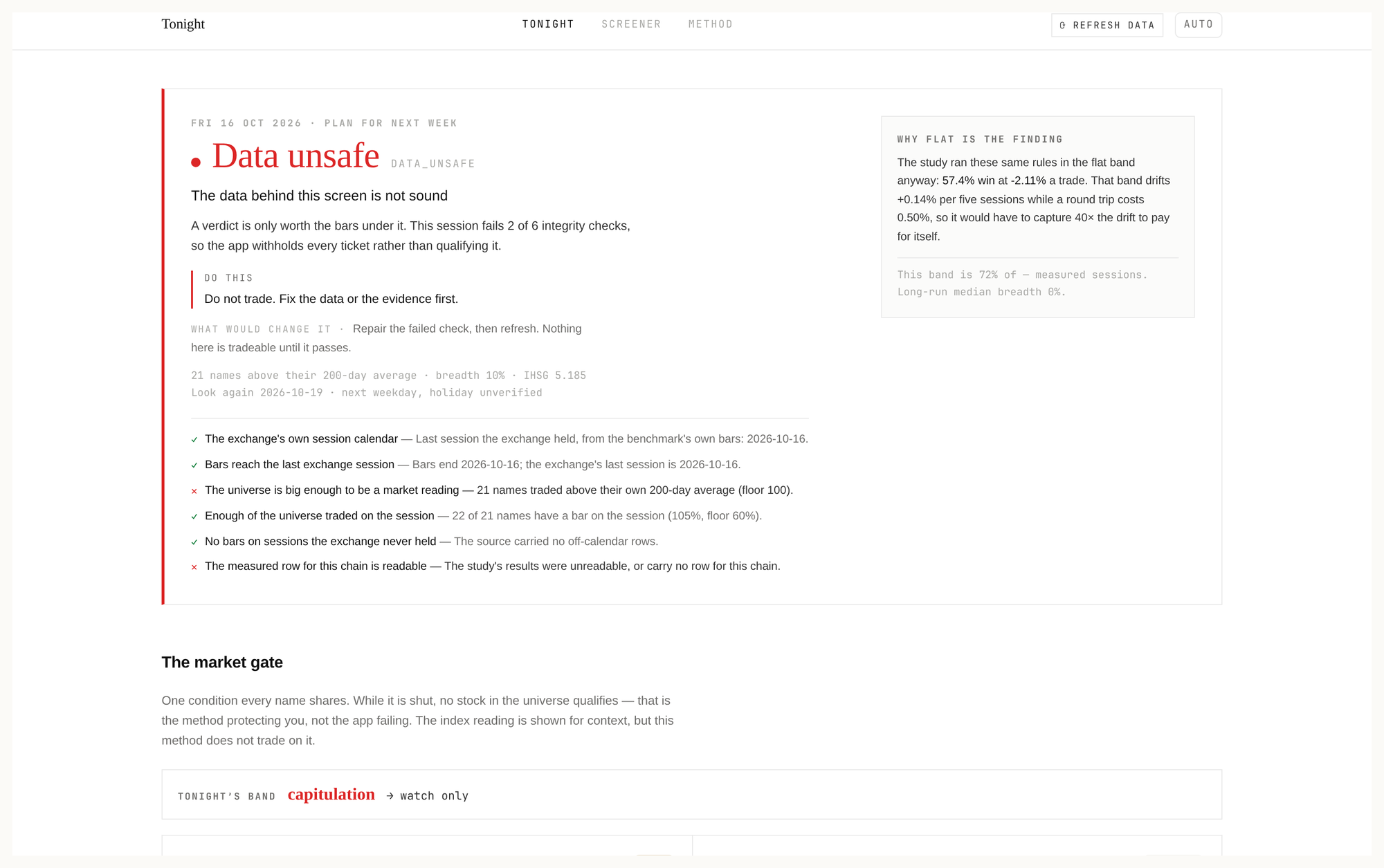
Tonight (/)Should I buy anything, and what exactly? The verdict, each ticket, the watchlist, and the case for standing down.
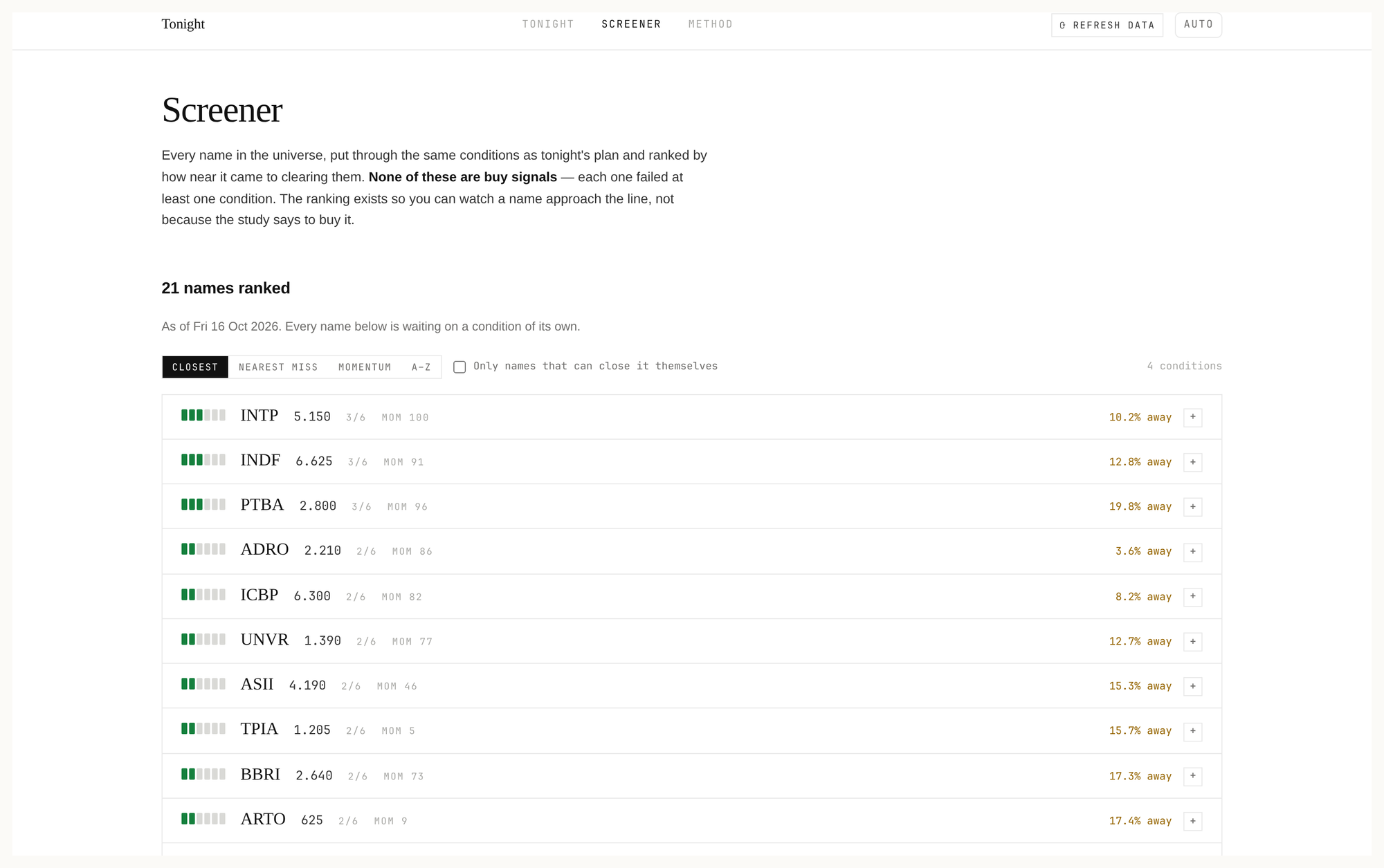
Screener (/screener)Every name, ranked by how near it is to being buyable — with no buy signals, on purpose.
Market (/market)The daily dashboard: breadth, the stress gauge, and weekly sector, conglomerate and industry rotation.
Flow (/flow)Technical cards and a transparent flow-pressure proxy. A research panel, not a plan input.
Method (/method)The rule chain, the corrected result, the horizons that were measured and refused, the costs, and every citation.
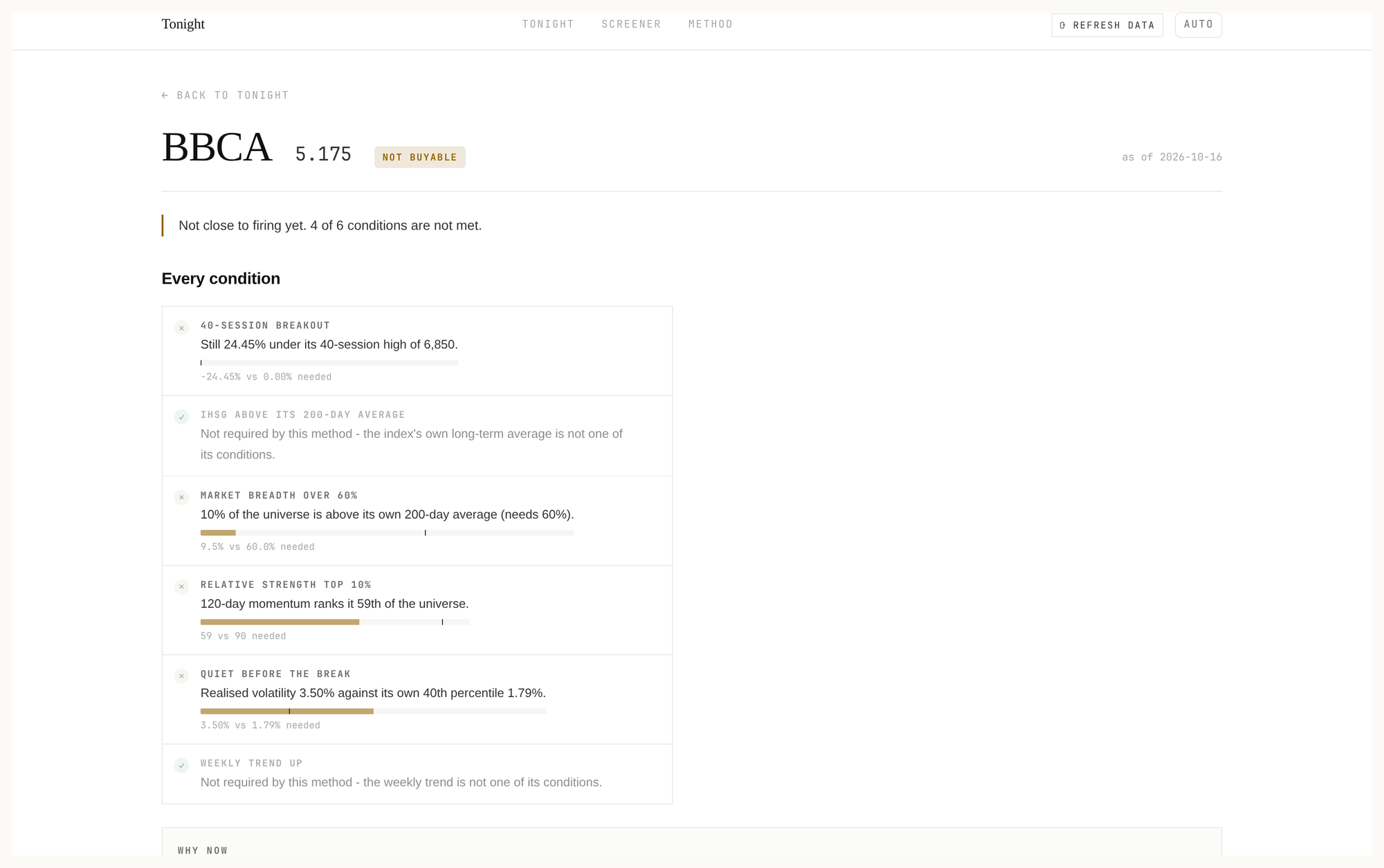
Name (/name/$ticker)One name: each condition and how long it has held, the run-up, levels, ticket and chart.
CLI./trading-suite plan, plan momentum, plan name TICKER, plan method, plan size — the same engine without a browser.

One verdict is produced per session, in strict precedence: ENTER → WAIT → NO_TRADE → DATA_UNSAFE. Six integrity checks — exchange calendar, bars current, universe size, coverage, phantom bars, evidence readable — must all pass before a ticket appears.

How it works

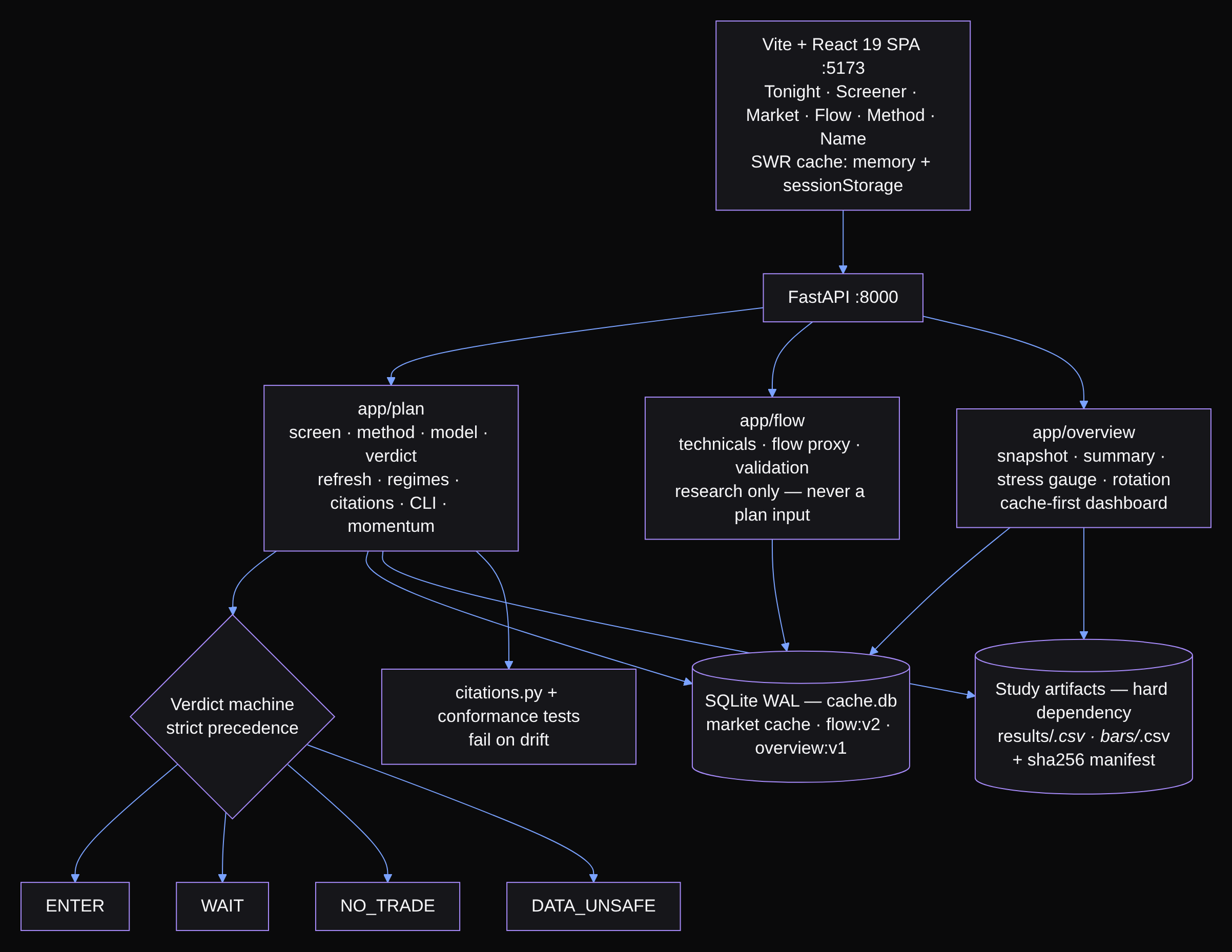
trading-suite architecture
Mermaid source (diagrams/trading-suite.mmd)
flowchart TD
  FE["Vite + React 19 SPA :5173<br/>Tonight · Screener · Market · Flow · Method · Name<br/>SWR cache: memory + sessionStorage"]

  API["FastAPI :8000"]

  PLAN["app/plan<br/>screen · method · model · verdict<br/>refresh · regimes · citations · CLI · momentum"]
  FLOW["app/flow<br/>technicals · flow proxy · validation<br/>research only — never a plan input"]
  OVER["app/overview<br/>snapshot · summary · stress gauge · rotation<br/>cache-first dashboard"]

  VERD{"Verdict machine<br/>strict precedence"}
  DB[("SQLite WAL — cache.db<br/>market cache · flow:v2 · overview:v1")]
  STUDY[("Study artifacts — hard dependency<br/>results/*.csv · bars/*.csv<br/>+ sha256 manifest")]
  CIT["citations.py + conformance tests<br/>fail on drift"]

  OUT["ENTER"]
  W["WAIT"]
  N["NO_TRADE"]
  U["DATA_UNSAFE"]

  FE --> API
  API --> PLAN
  API --> FLOW
  API --> OVER
  PLAN --> VERD
  PLAN --> DB
  PLAN --> STUDY
  PLAN --> CIT
  FLOW --> DB
  OVER --> DB
  OVER --> STUDY
  VERD --> OUT
  VERD --> W
  VERD --> N
  VERD --> U

Components

  • backend/app/plan/ — the nightly method: screen, method, model, verdict, refresh, regimes, citations, bars, plus the new cli and momentum modules.
  • backend/app/flow/ — technical cards and a causal flow-pressure proxy, deliberately outside the plan: the verdict cannot depend on it.
  • backend/app/overview/ — the Market dashboard. A background job builds one snapshot, and GET /api/overview only reads it; a warm request is a SQLite read, not a universe scan.
  • backend/app/computed_cache.py — the shared versioned SQLite cache for computed payloads (flow:v2:*, computed:overview:v1:*).
  • backend/app/routers/ and frontend-web/src/routes/ — thin HTTP and UI seams. All plan screens read the same engine.

One session, end to end

  1. Load bars. Resolve the source — study CSVs, else live — and read the benchmark first, because the index is the exchange calendar the ticker files are validated against.
  2. Drop phantom bars. Sessions the exchange never held are removed and counted, not silently accepted.
  3. Apply the market gate. Breadth is the share of the universe above its own 200-session average; the index's own stage comes next.
  4. Run the rule chain. A 40-session breakout, relative strength in the top 10%, and 20-session volatility in its own lowest 40%.
  5. Check integrity. Any failed check short-circuits to DATA_UNSAFE and withholds every ticket.
  6. Produce one verdict and attach the evidence. The corrected headline, the searched maximum labelled as a maximum, the haircuts, and the citation for each quoted figure.

Key choices

ChoiceWhyCost
Refusal is a product stateThe screener can show no buy signals, and the flat band is a documented finding. The app cannot manufacture a recommendation to look useful.A user who wants a hot list daily gets an empty screen.
DATA_UNSAFE outranks every signalIntegrity checks fail closed and suppress all output, with no warning that can sit beside a ticket.One bad ticker file can blank the whole session.
Evidence tiers are never blendedThe searched census, the walk-forward corrected row and the one-window replay are shown as three distinct things, each labelled.The headline is less impressive than the maximum.
The study stays the source of truthLive bars are merged in memory, never written back; Market caches a snapshot, but the study remains immutable.A cold start repeats the merge, and the study checkout is a hard dependency.

Running it

git clone https://github.com/mariobgsp/trading-suite && cd trading-suite

# backend
cd backend && python -m venv .venv && .venv/bin/pip install -r requirements.txt && cd ..
# frontend
cd frontend-web && npm install && cd ..

./trading-suite run        # backend :8000 + frontend :5173
./trading-suite plan       # tonight's verdict in the terminal
./trading-suite plan momentum
./trading-suite verify     # backend tests + frontend typecheck

The plan and Market read the study at TRADING_DOCS_DIR (default ~/Projects/trading-backtest-docs); Flow uses the app's own feeds.

What I observed

The study checkout is private, so I supplied a stand-in built by tools/capture/make-study-stub.py: real daily bars for 22 names, a real manifest, and no results/*.csv. The absence is the experiment. The app answered:

{
  "state": "DATA_UNSAFE",
  "action": "Do not trade. Fix the data or the evidence first.",
  "primary_blocker": {
    "key": "universe",
    "text": "21 names traded above their own 200-day average (floor 100)."
  }
}

Six checks were evaluated: four passed and two failed.

✓ exchange session calendar          last session: 2026-10-16
✓ bars reach the last session        bars end 2026-10-16
✗ universe is big enough             21 names (floor 100)
✓ coverage                           22 of 21 names have a bar (105%, floor 60%)
✓ no off-calendar bars               0
✗ measured row readable              results unreadable

That is the thesis in one screen: a 9.5% breadth reading against a 60% requirement, a capitulation band, real prices — and no ticket, because the evidence under it is incomplete. The repository's latest full run reports 248 backend tests passed, 6 skipped.
Screenshots

Tonight — DATA_UNSAFE

Tonight: the verdict, the action, and the six integrity checks that produced it.

Screener — ranked, no signals

The Screener on purpose: each row shows how near a name is to qualifying, not a signal.

One name — every condition

One name: every condition, its value, its threshold, and the distance between them.

What I'd fix next

  • A missing study checkout returns HTTP 500 instead of DATA_UNSAFE. default_source() falls back to LiveBars, but the loader calls source.load(None) and LiveBars.load() expects a list, so the request raises TypeError before the verdict can fail closed.
  • The Method screen has no error state. A failed request leaves "Loading the method…" on screen forever, so a slow load and a dead one look the same.
  • The deployment leftovers are stale. docker-compose.yml and the root Dockerfile still build the removed Next.js frontend; the PlantUML docs describe an earlier five-route desk.
  • Flow is a proxy, not the vendor's Liquidity Pressure Model. The formula and its data are proprietary. The UI says "proxy" and reports the proxy's forward-return record, not a parity claim.