Backend & API engineer
← All articles

[ 04 / 05 ] payment-system

One Go Binary Instead of Four Java Services

This payment system used to be four Java microservices on Kafka, Mongo and Zookeeper. It is now one Go binary, two Postgres schemas, and an outbox table doing the job the message broker used to do. All five containers start with one command.

Role
Backend engineering, distributed-systems consolidation, security hardening
Stack
Go (net/http stdlib) · PostgreSQL 15 · Redis 7 · Next.js portal · Docker Compose
Verified
Re-read against commit 084d207 (2026-10-28; a tailwindcss v3 pin that restores the frontend build). Screenshots and observed output are from the 2026-10-17 run.

At a glance

  • What it is — a storefront payment lifecycle: order → charge → signed callback → invoice → refund, with idempotency, authorization and audit logging.
  • Who it's for — teams paying the operational tax of microservices they do not need.
  • The interesting part — the outbox replaced Kafka without losing its guarantees: atomic writes, at-least-once delivery, retry with backoff, and a terminal dead-letter table.

The problem

The original design split the lifecycle across ms-order, ms-payment, ms-invoice and ms-logger, wired through Kafka, Mongo and Zookeeper. That architecture had real advantages — independent scaling, deploys and blast radius — none of which were used.

  • Nothing scaled independently. Order, charge and refund share one transaction boundary; splitting them made consistency a saga problem.
  • Kafka was delivery, not stream processing. Every message was consumed once, keyed to one transaction, with no replay beyond retry. A Postgres table and a poller cover that.
  • Mongo held logs with one access pattern: newest first, by transaction, with 30-day retention. That is a SELECT with an index.

The rewrite keeps the guarantees and removes the moving parts: one binary, one database, two schemas.

What it does

CapabilityHow
Transaction lifecycleTransactionLifecycle owns the status chart: CREATED → READY → SUCCESS → PUBLISHED, plus SUCCESS → REFUND and READY → FAILED.
IdempotencyIdempotency-Key on order creation; transactionId for charge and refund. Key and transaction share one commit.
Atomic outboxThe transaction row, its outbox row and its idempotency record are written in one commit, so a state change cannot exist without its event.
Signed callbacksx-callback-signature (HMAC-SHA256) and x-callback-timestamp, checked against a 300-second replay window. Forgeries get 401.
Retry and dead-letteringA 5-second poller retries three times with backoff, then writes to dlq.* and never redelivers.
Sweeping and invoicingA 60-second sweeper fails stale READY rows after five minutes. The poller writes one invoice per settled transaction.
Sessions and auditShort-lived opaque session tokens, login rate limiting, and GET /v1/logs?limit= over retained audit rows.

How it works

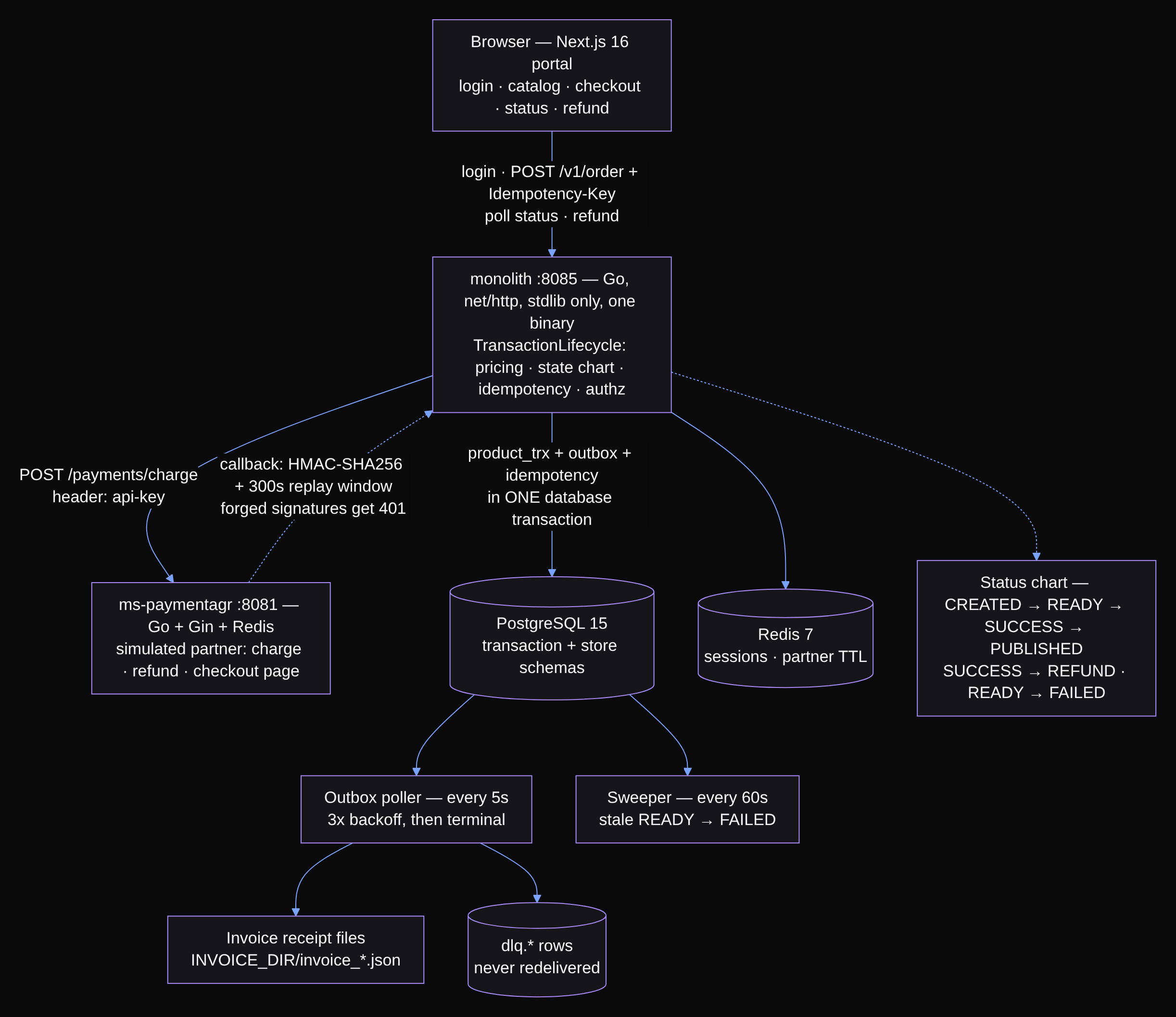
payment-system architecture
Mermaid source (diagrams/payment-system.mmd)
flowchart TD
  FE["Browser — Next.js 16 portal<br/>login · catalog · checkout · status · refund"]

  MONO["monolith :8085 — Go, net/http, stdlib only, one binary<br/>TransactionLifecycle: pricing · state chart · idempotency · authz"]

  PARTNER["ms-paymentagr :8081 — Go + Gin + Redis<br/>simulated partner: charge · refund · checkout page"]

  PG[("PostgreSQL 15<br/>transaction + store schemas")]
  REDIS[("Redis 7<br/>sessions · partner TTL")]
  POLL["Outbox poller — every 5s<br/>3x backoff, then terminal"]
  INV["Invoice receipt files<br/>INVOICE_DIR/invoice_*.json"]
  DLQ[("dlq.* rows<br/>never redelivered")]
  SWEEP["Sweeper — every 60s<br/>stale READY → FAILED"]
  FLOW["Status chart — CREATED → READY → SUCCESS → PUBLISHED<br/>SUCCESS → REFUND · READY → FAILED"]

  FE -->|"login · POST /v1/order + Idempotency-Key<br/>poll status · refund"| MONO
  MONO -->|"product_trx + outbox + idempotency<br/>in ONE database transaction"| PG
  MONO -->|"POST /payments/charge<br/>header: api-key"| PARTNER
  PARTNER -.->|"callback: HMAC-SHA256 + 300s replay window<br/>forged signatures get 401"| MONO
  MONO --> REDIS
  PG --> POLL
  POLL --> INV
  POLL --> DLQ
  PG --> SWEEP
  MONO -.-> FLOW

Components

  • monolith/lifecycle/ — the deep module: status chart, pricing, idempotency, authorization. Every caller that moves a payment goes through it.
  • monolith/store/ — the persistence seam: pg.go for production, memory.go as a fake. The end-to-end suite runs on the fake with no database.
  • monolith/jobs/ — the outbox poller and the sweeper, each readable in one sitting.
  • monolith/cmd/ — the route table, the new API, the legacy compatibility surface, and the envelopes and transports in http.go.
  • ms-paymentagr/ — the simulated partner. An external partner is a different failure domain: a separate binary with a signed callback.

One payment, end to end

  1. Sign in. BCrypt verification against store.store_user; the monolith issues a short-lived opaque session token.
  2. Place the order. Price and discount are computed in TransactionLifecycle, then the CREATED transaction, one outbox row and one idempotency row are inserted in a single transaction.
  3. Create the charge. CREATED → READY; the partner is called with an api-key header. A duplicate call returns the same CheckoutUrl.
  4. Receive the callback. The partner posts a signed event; the monolith verifies HMAC and timestamp, then moves READY → SUCCESS/PUBLISHED and writes an outbox row.
  5. Sweep and retry. The poller routes the outbox (three attempts, then dead-letter); the sweeper fails stale READY rows after five minutes.
  6. Settle and refund. The poller writes the invoice. A refund moves SUCCESS → REFUND; a second refund returns 409.

Key choices

ChoiceWhyCost
Outbox in the same transactionThe state change and the event are one commit, so "payment succeeded but nothing was notified" cannot happen.Outbox rows live in the hot database and need retention.
Terminal DLQA malformed event cannot pin a worker, and the failure is visible as data.Someone must look at the DLQ.
Monolith until measuredThe split triggers are named: merge contention, diverging resources, or a crash that takes the lifecycle down.One deployable.
Fail closed on the partnerPartner errors return 502 instead of marking the payment READY.A partner outage stops new payments.

Running it

cd project
cp .env.example .env          # change every secret
docker compose up --build     # postgres + redis + partner + monolith + frontend

# portal       http://localhost:3000
# monolith API http://localhost:8085   (/health, /v1/logs)
# partner      http://localhost:8081   (/health)

cd monolith && go vet ./... && go test ./... -count=1
cd ms-paymentagr && go vet ./... && go build ./...
cd frontend && npm ci && npm run build

The frontend build is the one command that was not green for a while. At 0f2acef a dependabot major bump had moved tailwindcss to 4.3.3 while globals.css still uses the @tailwind base/components/utilities directives, tailwind.config.ts uses the v3 Config type, and postcss.config.mjs registers tailwindcss as a PostCSS plugin, which v4 no longer supports, so the build stops:

Error: It looks like you're trying to use `tailwindcss` directly as a PostCSS plugin.
The PostCSS plugin has moved to a separate package, …

084d207 pins it back to ^3.4.19. I ran both sides in a clean worktree rather than trusting the commit message: exit 1 at 0f2acef with tailwind 4.3.3 installed, exit 0 at 084d207 in 41 s.

What I observed

The five-container stack came up clean and the lifecycle ran end to end. The status chart walked CREATED → READY → SUCCESS → REFUND, and the invoice contains exactly the settled state:

{
  "paymentStatus": "SUCCESS",
  "priceCharge": 61557,
  "transactionId": "PTRX-22b7a774"
}

Driving the stack surfaced two real defects.

Screenshots

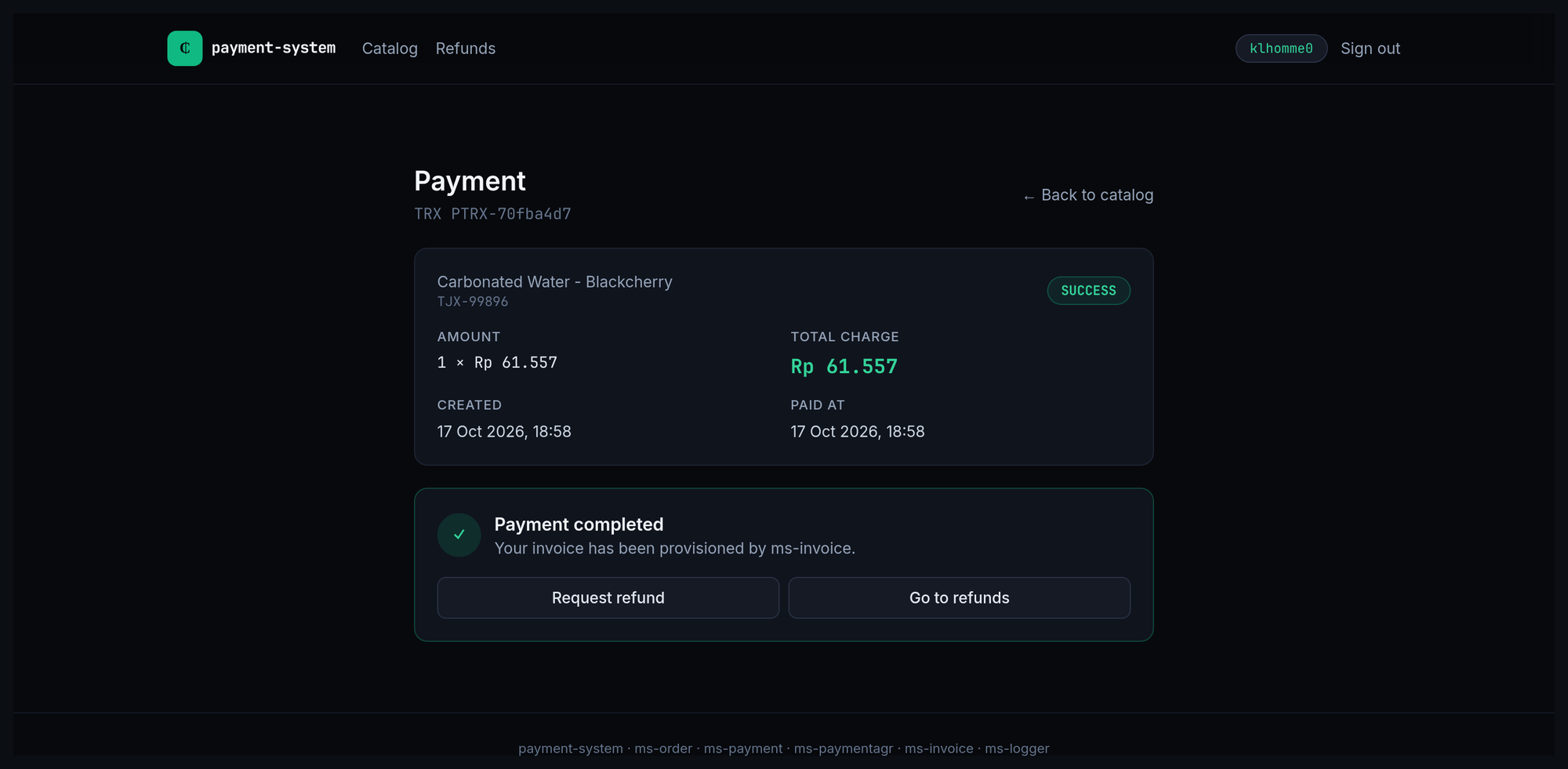
Checkout — SUCCESS

SUCCESS after the signed callback; the outbox poller wrote the invoice.

The partner's checkout endpoint

The partner's side. It reports success while the monolith can stay at READY — the callback defect below.

What I'd fix next

1 — The legacy endpoint answers in snake_case, and the checkout page reads camelCase, so the page crashes. /v1/* returns transactionId and priceCharge; /ms/api/v1/* returns transaction_id and price_charge. The page expects camelCase, so formatIdr(trx.priceCharge) gets undefined and React unmounts into an error boundary. Normalise the legacy response in the BFF, or pin the contract with a shared type.

2 — The partner's callback key does not match the monolith's contract, so a payment can never reach SUCCESS through the normal partner flow. ms-paymentagr signs and sends reference_id; the monolith's CallbackEvt reads referenceId. Go does not match across an underscore, so the identifier arrives empty and the callback is rejected:

{"reference_id":"PTRX-22b7a774", ...}  ->  HTTP 400  invalid callback
{"referenceId": "PTRX-22b7a774", ...}  ->  HTTP 202  Request being processed

The signature is correct; the payment sits at READY until the poller gives up. Map the payload in one place, or assert the shape in the partner's tests.

3 — The Tailwind 4 migration is deferred, not done. Pinning ^3.4.19 restores the build, but the codebase is still v3-only: a real move needs @tailwindcss/postcss, @import "tailwindcss" instead of the three directives, and a CSS-first theme, plus a visual pass over every screen. Until then a major bump can break the default branch again, which is what happened here.

4 — Smaller items. Postgres is pinned to an unmaintained 15-alpine3.17; seeded users ship real BCrypt hashes; and payment_date is set at READY, not settlement.