Backend & API engineer
← All articles

[ 05 / 05 ] the-gateway

An API Gateway That Keeps JWTs Out of the Browser

The Gateway is a small API-management console: define the upstream APIs you call, allowlist what may reach them, and test them from the UI. The interesting part is not the CRUD. It is that the session token never becomes readable by a single line of browser JavaScript.

Role
Backend (Go) + full-stack engineering
Stack
Next.js 15 (BFF) · Go 1.26 + chi + pgx · PostgreSQL 15 · Docker Compose / Kubernetes
Verified
Re-read against 82acad0 (2026-10-25; tooling-only). Screenshots from the 2026-10-17 run.

At a glance

  • What it is — a control plane for outbound HTTP APIs plus a runtime that executes them. Each ApiGateway record stores the host, path, method, header and parameter allowlists, and a required-body gate.
  • Who it's for — teams that call many third-party APIs and want one place to see, constrain and test them without exposing a credential to the browser.
  • The interesting part — the trust boundary is the Next.js server, not the SPA. Every backend call is a server-side fetch behind an httpOnly cookie, and every upstream call re-enforces the allowlists in the database.

The problem

Most SPA-plus-API projects end up with two problems.

1 — The token is readable by any script on the page. A JWT in localStorage means one injected script or compromised dependency is a full account takeover.

2 — Any URL the browser can name, the server will fetch. A gateway that forwards whatever path, header or query it is handed is an open proxy. An attacker can reach unconfigured hosts, leak credentials, or use your service as an SSRF pivot.

This project answers both by construction: the browser holds an opaque cookie it cannot read, and the Go service derives the outbound request from persisted configuration, not the incoming request.

What it does

CapabilityHow
Upstream API registryNamed ApiGateway records: identifier, host, path, method, allowlists, body gate, status.
Store accountsMachine principals with a client id and secret, tied to a user.
Server-side sessionLogin mints a JWT into an httpOnly, SameSite=Lax cookie, Secure in production. The browser never reads it.
Guarded forwardingGatewayForward resolves the stored config, filters headers and parameters, encodes the URL once, enforces the body gate, then calls upstream.
Try-it consoleRun a configured API from the UI and see the raw upstream response.
Envelope contractOne shape: code: "00" is success; other codes name specific faults.
Two deploy pathsDocker Compose locally, Kubernetes manifests for a cluster.

How it works

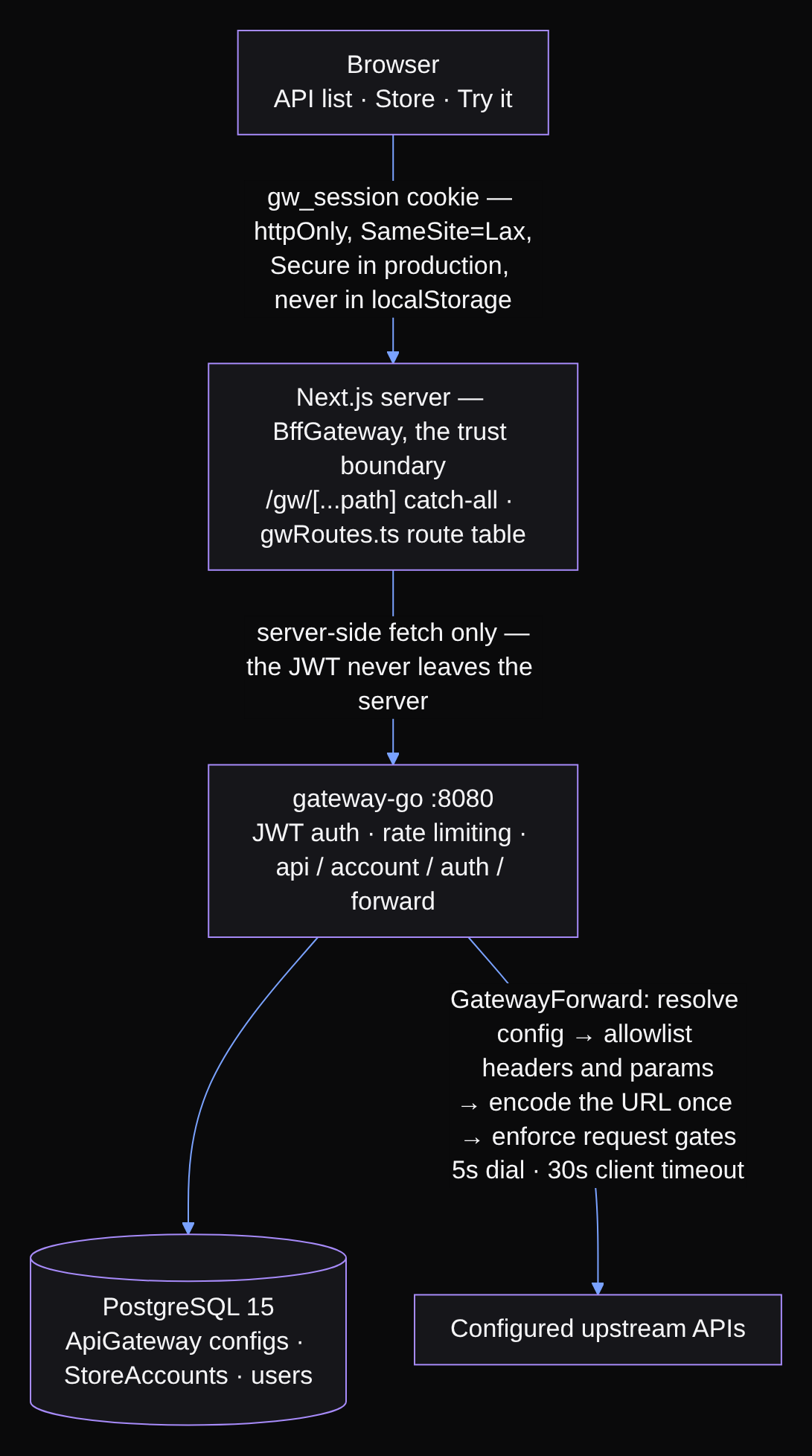
The Gateway architecture
Mermaid source (diagrams/the-gateway.mmd)
flowchart TD
  BR["Browser<br/>API list · Store · Try it"]

  BFF["Next.js server — BffGateway, the trust boundary<br/>/gw/[...path] catch-all · gwRoutes.ts route table"]

  GO["gateway-go :8080<br/>JWT auth · rate limiting · api / account / auth / forward"]

  STORE[("PostgreSQL 15<br/>ApiGateway configs · StoreAccounts · users")]
  UP["Configured upstream APIs"]

  BR -->|"gw_session cookie — httpOnly, SameSite=Lax,<br/>Secure in production, never in localStorage"| BFF
  BFF -->|"server-side fetch only —<br/>the JWT never leaves the server"| GO
  GO --> STORE
  GO -->|"GatewayForward: resolve config → allowlist headers and params<br/>→ encode the URL once → enforce request gates<br/>5s dial · 30s client timeout"| UP

Components

  • frontend/src/app/gw/[...path]/route.ts — the catch-all HTTP adapter. Every browser-to-backend call enters here.
  • frontend/src/lib/bffGateway.ts — BffGateway owns session lookup, the unauthorized response, the backend fetch, the timeout and envelope translation. Sanitisation is private, so no call site can forget it.
  • frontend/src/lib/gwRoutes.ts — the declarative route table that maps /gw/* paths onto backend paths.
  • gateway-go/internal/handler/ and internal/service/forward.go — the router, auth middleware and ForwardRequest, the typed seam that keeps forwarding policy testable without a socket.
  • gateway-go/internal/store/ and internal/api/ — one file per entity over a shared Postgres connection, plus the envelope and its error codes.

One browser click, end to end

  1. The page calls a literal /gw/... path; no user-constructed URL reaches the fetch sink.
  2. gwRoutes.ts matches the path and resolves the backend path.
  3. BffGateway reads the gw_session cookie. If missing or invalid, it returns an envelope error without calling the backend.
  4. The server-side fetch runs with the JWT in Authorization, under a timeout and AbortController.
  5. gateway-go authenticates the JWT and loads the stored ApiGateway record.
  6. GatewayForward builds the URL from the stored host and path, filters headers and query parameters down to the allowlists, enforces the body gate, and calls upstream.
  7. The upstream response is mapped into the envelope, then mapped once more for the browser.

Key choices

ChoiceWhyCost
Next.js server as the trust boundaryThe token must live where the browser cannot read it; the BFF is already there for the UI.Every backend call costs a server round-trip; the BFF is another deployment unit.
httpOnly + SameSite=Lax cookieRemoves the token from JavaScript; the cookie policy provides CSRF protection.The server must set COOKIE_SECURE correctly behind TLS.
Allowlists enforced twiceThe BFF sanitises what it forwards; the Go service re-derives the request from persisted config.A header allowed in config but stripped by the BFF fails confusingly.
Encode the URL exactly onceTolerant query parsing; canonical encoding in one place (service.BuildForwardURL).Callers must know the tolerant-parse policy.
One envelope for every faultOne UI error path; stable, documentable codes.An extra translation step for upstream bodies.

Running it

cd project && docker compose up -d postgres
psql "$DATABASE_URL" -f project/pg-init-scripts/gateway.sql

docker compose up -d --build          # postgres + gateway-go (8080) + frontend (3000)

cd gateway-go && go build ./... && go vet ./... && go test ./...
cd frontend   && npm run lint && npm run typecheck && npm test && npm run build

What I observed

After login, from inside the page:

document.cookie => ""
session cookie  => gw_session httpOnly=true sameSite=Lax
BFF 200 /gw/auth/login
BFF 200 /gw/apis

The cookie exists and every backend call went through the BFF, yet document.cookie is empty: the token is unreadable.

The Try-it console also surfaced an environment fact: a public upstream failed with x509: certificate signed by unknown authority because the container lacked this network's intercepting CA. The gateway returned the real error instead of a generic 500; an internal endpoint completed the round trip.
Screenshots

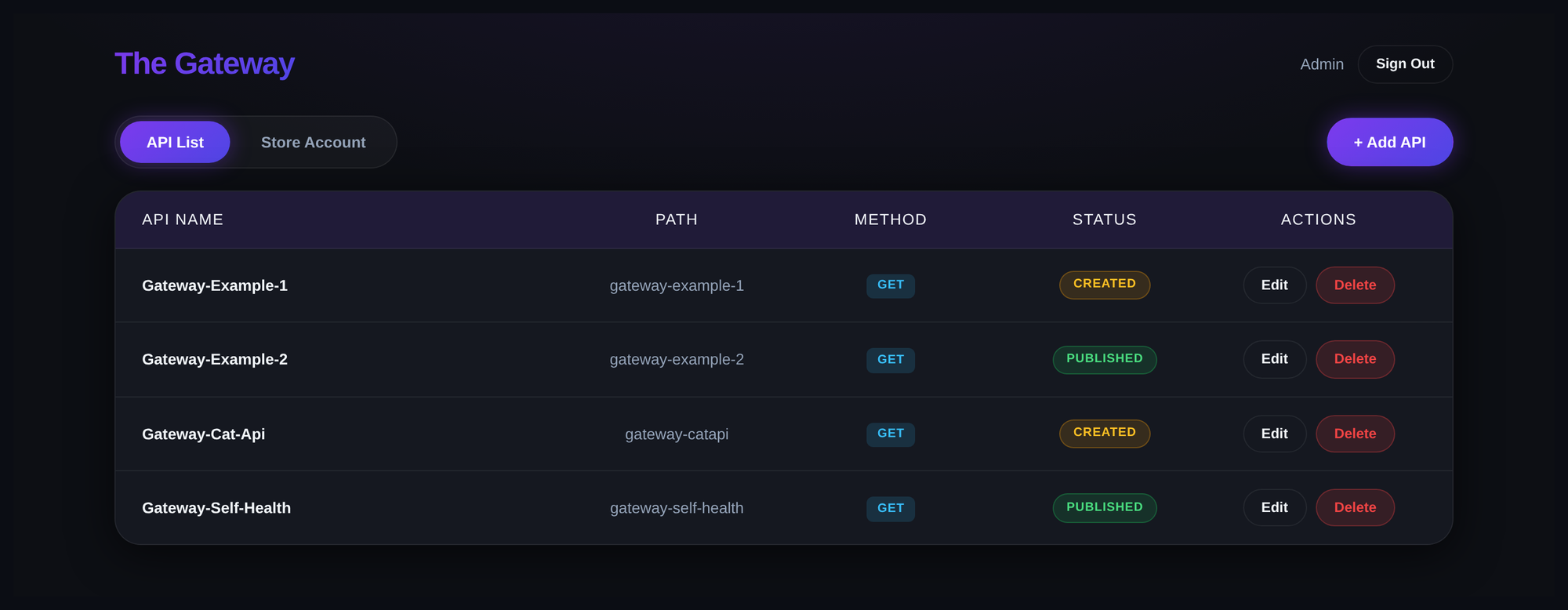
API list dashboard

The API list: name, identifier, method badge and lifecycle status.

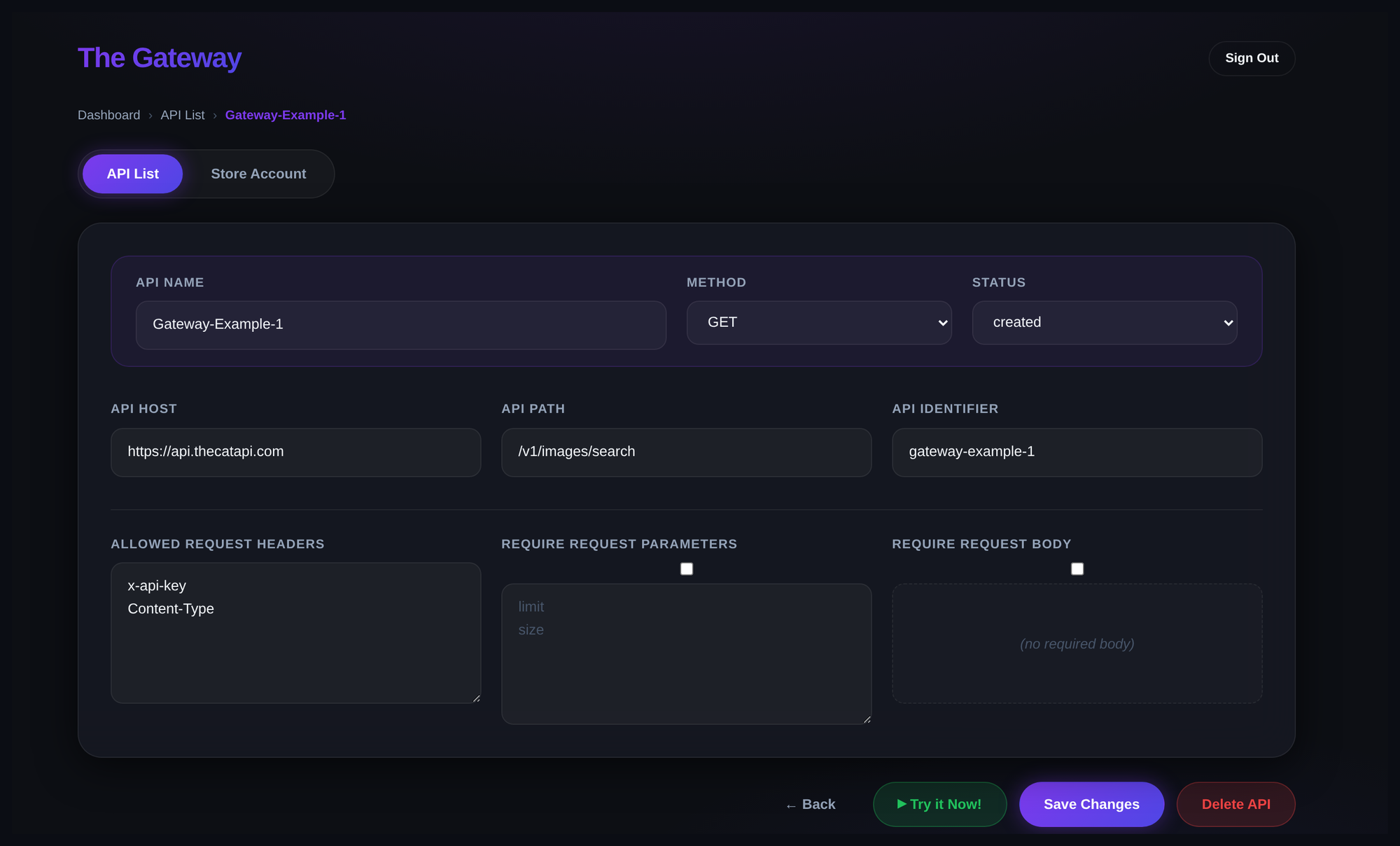
API configuration detail

One API's configuration; the lower row is the security surface.

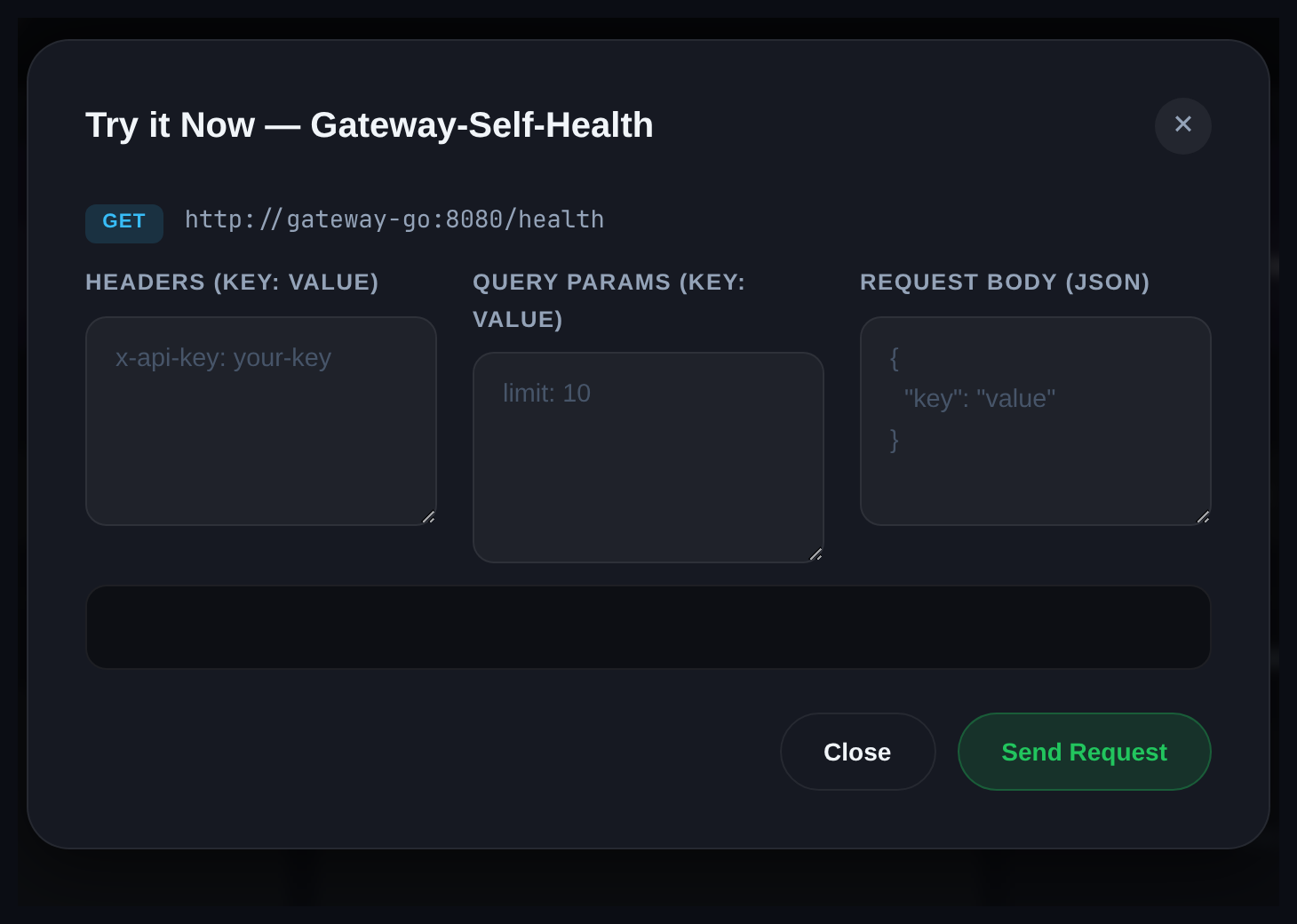
Try it console

The Try-it console issues a real request through the whole pipeline.

What I'd fix next

  • The schema is a separate step. Compose mounts the init SQL, but a native run needs psql -f before the UI has anything to show. A boot migration or a "0 APIs configured" readout would explain a first run.
  • test:e2e uses port 3001 to avoid a local dev server; a busy port makes a run appear to hang.
  • COOKIE_SECURE must be true behind TLS. The Compose file sets it to false for local HTTP, correct locally and wrong anywhere else.
  • Forwarding inherits the host's CA trust; a slim container store rejects upstreams the host accepts.